
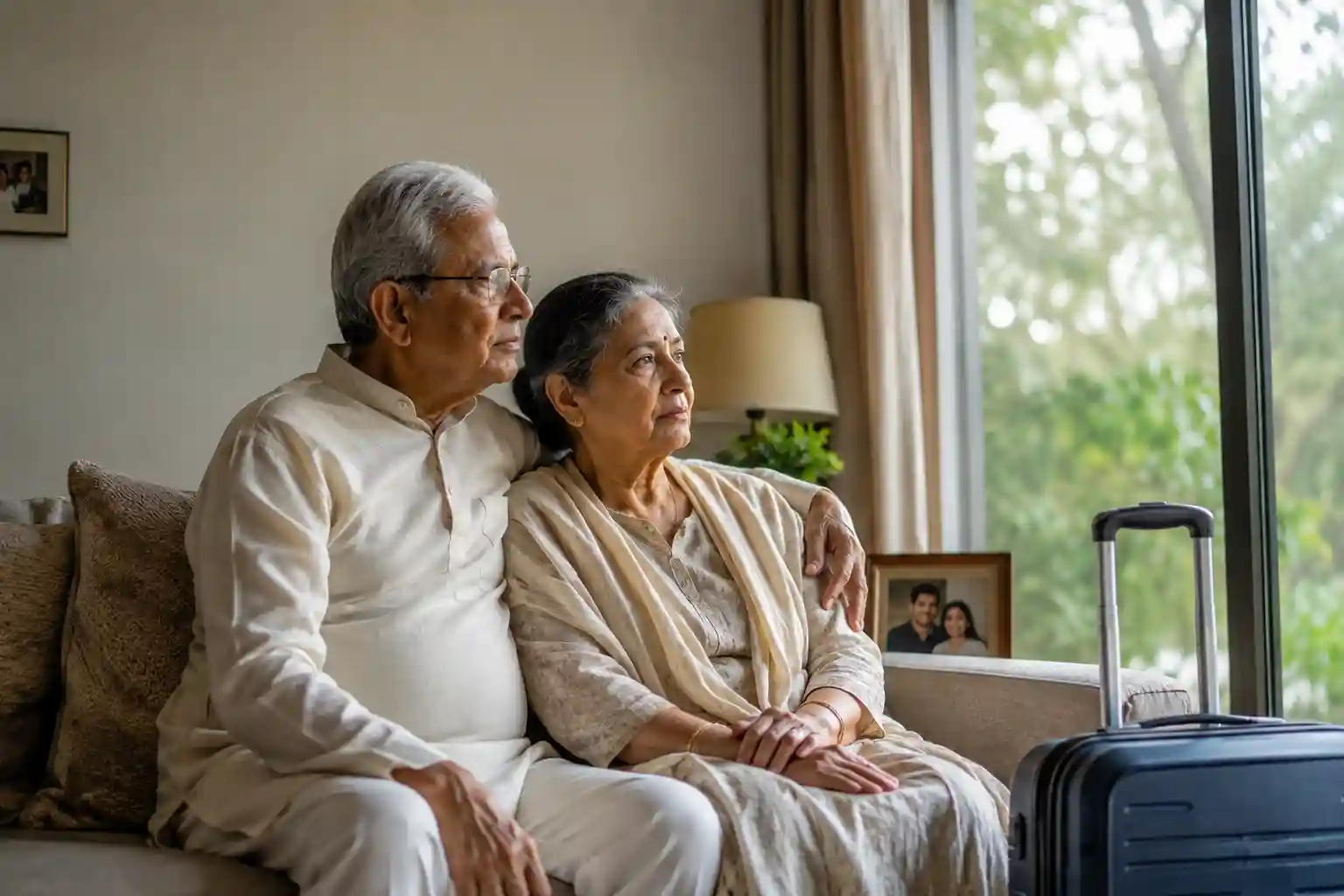
For many Indians living abroad, returning to India was once a decision reserved for retirement.
Perhaps it would happen after the children finished school. Maybe it would come after the mortgage was paid off, the career had reached its peak, or enough financial security had been created to finally come home.
But life does not always follow the plan we make for it.
For many NRI families, another question is becoming increasingly difficult to ignore:
What happens when our parents begin to need us?
A father who once drove everywhere may now find long journeys exhausting. A mother who managed the household independently may gradually need help with medicines, mobility or medical appointments. Meanwhile, the parent who always said, “I am perfectly fine,” may quietly begin to need someone nearby.
For an NRI living thousands of kilometres away, a video call can provide love and reassurance. However, it cannot always provide the physical presence an ageing parent may need.
That is why a deeply personal question is emerging for families across the world:
Can we continue building our lives abroad while ensuring that our parents in India age safely, comfortably and with dignity?
Recent media reports have brought this dilemma into public conversation. In July 2026, NDTV reported the story of an Indian technology professional who returned to Bengaluru after 18 years in the United States, citing ageing parents and family considerations among the reasons for his decision. Earlier in January, another NDTV report described an NRI who returned to India after 12 years in the US to care for ageing parents.
These individual stories do not establish that most NRIs are returning to India. Nevertheless, they illustrate a question that many families may eventually face:
How do we care for our parents when distance separates us?
The NRI Dream Changes When Parents Grow Older
For decades, the NRI journey followed a familiar pattern.
First came education and a career abroad. Then came professional growth, financial stability and perhaps permanent residency or citizenship. Children were born and raised overseas, homes were purchased, and new lives took shape.
India remained home, but increasingly became a place visited during holidays.
At first, everything worked.
Parents were independent. They travelled, met friends, managed their homes and looked after themselves. Regular calls and annual visits seemed sufficient.
Then, gradually, ageing changed the equation.
Ageing rarely arrives as one dramatic event. Instead, it often appears through small changes.
A parent stops driving at night.
Stairs become difficult.
Hospital visits become more frequent.
Medicines become more complicated.
A fall takes longer to recover from.
Loneliness begins to replace an active social life.
Eventually, the question that once seemed far away becomes immediate:
“Who will be there when I cannot be?”
The Distance Between an NRI Child and Ageing Parents
Living abroad can offer wonderful opportunities. At the same time, distance creates a unique caregiving challenge.
An NRI can call every day, arrange appointments, send money and book a flight within hours. Yet none of these things guarantees that someone will be physically present when a parent falls, develops a sudden health problem or needs assistance getting to hospital.
A Phone Call Cannot Lift Someone After a Fall
Technology has transformed long-distance family relationships.
Video calls allow children to see their parents. Messaging apps make communication instant. Digital payments make financial support easier.
Even so, ageing can create needs that technology cannot solve.
A parent may need someone to:
- Accompany them to a doctor
- Help them move safely around the home
- Assist with daily routines
- Provide medication reminders
- Help with bathing, dressing or toileting
- Provide companionship
- Notice changes in their condition
- Coordinate with family members during an emergency
Therefore, the challenge for NRI families is not simply communication.
It is dependable physical support.
Why Returning to India Can Become an Emotional Decision
Returning to India for ageing parents is rarely just a career decision.
Instead, it can become a deeply emotional one.
An NRI may suddenly look at a parent and realise that the person who spent decades caring for them now needs care themselves.
The father who once drove his child to school may now need assistance reaching a hospital.
The mother who spent years worrying about her children’s future may quietly worry about becoming a burden.
As a result, the son or daughter may begin asking difficult questions.
Should I leave my job?
Should my children move schools?
Should we give up the life we built abroad?
Will I regret staying away?
Will I regret coming back?
These are not merely financial questions.
They are questions about love, responsibility, identity and time.
Recent Stories Put a Human Face on the Dilemma
The subject has appeared repeatedly in Indian media during 2025 and 2026.
For example, an NDTV report in January 2026 described an NRI who felt conflicted about returning to India to look after ageing parents while also considering the future of his children abroad.
Similarly, NDTV reported in July 2026 on an NRI technology professional who returned to Bengaluru after 18 years in the United States to support ageing parents and raise his children closer to extended family.
Another NDTV report in July highlighted a Bengaluru man who had moved back from Canada years earlier to be closer to his ageing parents.
These are personal stories rather than statistical proof of a mass return.
Nevertheless, they demonstrate something important:
For some families, the value of being physically close to ageing parents eventually becomes part of the definition of a successful life.
India Is Ageing—and That Changes the Family Equation
The NRI-parent dilemma is not happening in isolation.
India itself is undergoing a major demographic transition.
According to UNFPA, India’s elderly population is projected to rise dramatically, reaching about 346 million people aged 60 and above by 2050, or nearly 21% of the population.
The change is particularly significant among the oldest age groups. UNFPA’s India Ageing Report 2023 projected that India’s population aged 80 and above could grow by around 279% between 2022 and 2050.
Consequently, eldercare is no longer simply a private family concern.
It is becoming an increasingly important social, healthcare and community issue.
Longer Life Can Also Mean Longer Care Needs
Living longer is one of the great achievements of modern healthcare.
However, longevity can also mean that families spend more years navigating changing health and care needs.
An older person may remain completely independent for years. Gradually, however, support may become necessary.
Initially, it might be transportation.
Later, medication management.
After that, mobility assistance.
Eventually, some seniors may require personal care, dementia supervision, post-hospitalisation support or continuous assistance.
Therefore, families should think about eldercare not as a single event but as a continuum of support.
The Government of India’s National Programme for Health Care of the Elderly also recognises the need for integrated promotional, preventive, curative and rehabilitative services for older people.
Why Many Parents Don’t Ask Their Children to Come Home
There is another emotional dimension that deserves attention.
Many parents do not want their children to return.
They may say:
“Don’t worry about us.”
“You have your own family.”
“Your children need you there.”
“We are managing.”
Often, they genuinely mean it.
Parents may not want their children to sacrifice careers, education or financial security because of them. Consequently, they may hide the difficulties they are experiencing.
A fall becomes “nothing serious.”
A hospital visit becomes “just a routine check-up.”
Loneliness becomes “I am used to it.”
Yet behind those words may be a very different reality.
The parent may simply be trying not to become a burden.
For this reason, conversations about ageing and future care should begin before a crisis.
Returning to India Is Not the Only Solution
Perhaps the most important point is this:
An NRI does not have to choose between abandoning life abroad and bringing everything back to India.
There is a wide middle ground.
Depending on the family’s circumstances, an NRI may choose to:
Return to India permanently
For some families, returning home may be the most meaningful decision.
Spend more time in India
Others may divide their time between countries, particularly after retirement or when parents’ needs increase.
Move parents closer to relatives
If appropriate, parents may relocate closer to trusted relatives or family members.
Arrange professional homecare
A dependable caregiver can provide physical assistance when family members cannot be present.
Combine family and professional care
For many families, this can be a practical middle path.
The family remains emotionally and financially involved, while professional caregivers provide day-to-day physical support.
In other words, professional eldercare does not replace family. It helps family remain present—even across continents.
The Growing Importance of Professional Eldercare
As Indian families become geographically dispersed, professional eldercare can play an increasingly valuable role.
For an NRI, the biggest question is often not:
“Can I find someone to help my parents?”
It is:
“Can I trust someone to look after them when I am not there?”
That distinction matters.
Professional eldercare should involve more than simply placing a person in a home. Families should consider caregiver suitability, training, supervision, communication, accountability and escalation procedures.
What Professional Eldercare Can Provide
Depending on an individual’s needs, support may include:
- Personal care
- Mobility assistance
- Companionship
- Medication reminders
- Assistance with daily activities
- Doctor appointment support
- Hospital accompaniment
- Post-hospitalisation care
- Dementia care
- Parkinson’s care
- Bedridden care
- Palliative support
- Regular family communication
Most importantly, the care plan should be individualised.
An active 70-year-old living independently does not need the same level of support as an 85-year-old recovering from surgery.
Home Is Often Where Older Parents Feel Most Comfortable
For many seniors, home is much more than a building.
It is where memories live.
It is where their children grew up.
It is where photographs hang on the walls and familiar neighbours know their names.
Consequently, moving to an unfamiliar environment can be emotionally difficult, particularly when an older person is already coping with illness, reduced mobility or cognitive changes.
Where appropriate, ageing in place can allow seniors to remain in familiar surroundings while receiving the assistance they need.
That approach also fits within the broader shift toward strengthening elderly healthcare and support closer to where older people live. India’s NPHCE provides an integrated framework for elderly health services across different levels of government healthcare.
Homecare Can Change as Needs Change
Importantly, homecare does not necessarily mean 24-hour care from day one.
A family might begin with:
Periodic support → regular visits → daytime caregiving → extended hours → 24×7 care
The appropriate arrangement can change as the parent’s circumstances change.
This flexibility is especially useful for NRI families because the child’s emotional involvement can remain constant even when the parent’s physical care needs evolve.
Caregiving Is Not the Same as Domestic Help
This distinction is extremely important.
A domestic worker primarily performs household tasks.
A caregiver’s role, by contrast, is centred on the person receiving care.
Depending on training and the care plan, responsibilities may include assistance with bathing, dressing, feeding, mobility, toileting, transfers and companionship. A caregiver may also observe changes that need to be communicated to family members or healthcare professionals.
Therefore, families should not select a caregiver simply because someone is available.
Instead, they should consider:
- Training
- Experience
- Reliability
- Background verification
- Supervision
- Communication
- Emergency responsiveness
- Suitability for the parent’s condition
For an NRI family, these factors become even more important because the child cannot physically supervise the arrangement every day.
The Financial Reality of Returning to India
Of course, emotions are only one part of the equation.
Returning to India can have significant financial consequences.
An NRI may need to consider:
- Salary differences
- Income tax
- Foreign assets
- Investments
- Retirement planning
- Children’s education
- Housing
- Health insurance
- Immigration status
- Currency differences
- Career progression
Financial planning therefore deserves careful attention before making a permanent move.
Recent reporting has also highlighted the need for NRIs returning to India to consider issues surrounding tax residency, foreign assets and financial planning.
At the same time, healthcare costs and parental health insurance deserve attention. Recent Economic Times reporting noted that rising healthcare expenses are prompting NRIs to reassess health insurance coverage for parents in India.
Consequently, returning for parents should ideally be a planned family decision rather than an emergency reaction.
But Not Everything Can Be Measured in Money
And yet, there is another calculation that spreadsheets cannot capture.
What is the value of having breakfast with your parents on a Sunday?
What is the value of taking your father to a doctor’s appointment?
What is the value of watching your children build memories with their grandparents?
What is the value of being there when your mother needs you?
These things do not appear on a balance sheet.
For some families, a lower salary in India may be worth the emotional closeness.
For others, remaining abroad may be necessary to provide long-term financial security.
Neither decision makes someone a better or worse son or daughter.
The right decision is the one that balances responsibility, reality and dignity.
A New Definition of Success for NRI Families
Perhaps this is where the conversation is changing most significantly.
For one generation, success meant getting an overseas job.
For another, it meant obtaining permanent residency.
For yet another, it meant building wealth and giving children a global education.
Today, however, success may have a broader meaning.
It may also mean:
Building a life in which our parents can age with dignity.
That does not necessarily require giving up life abroad.
Instead, it means recognising that ageing is inevitable and planning for it with the same seriousness with which we plan careers, investments and our children’s education.
What NRI Families Should Do Before a Crisis
The best eldercare plan is rarely created in the middle of an emergency.
Instead, families can begin with a few practical conversations.
1. Talk to Your Parents
Ask what they want if they become less independent.
Do they want to remain at home?
Who would they trust to help them?
Would they consider professional caregiving?
What kind of support would make them comfortable?
Although these conversations may feel uncomfortable initially, they can prevent much more difficult decisions later.
2. Understand Their Health Situation
Know their doctors, medications, diagnoses, allergies and emergency contacts.
Furthermore, keep important medical information accessible to trusted family members.
3. Assess the Home
Look for potential risks such as:
- Slippery bathrooms
- Poor lighting
- Loose carpets
- Difficult stairs
- Unsafe furniture
- Lack of grab bars
- Mobility obstacles
Small modifications can sometimes make a significant difference.
4. Create an Emergency Plan
Ask one simple question:
“If something happens tonight, who can reach my parents quickly?”
If the answer is unclear, the family needs a plan.
5. Review Health Insurance
Healthcare needs can change considerably as parents age.
Therefore, NRI families should periodically review health insurance coverage and understand exclusions, waiting periods, network hospitals and claim procedures.
6. Build a Local Support Network
Neighbours, relatives, doctors, friends and professional caregivers can all play different roles.
No single person needs to carry the entire responsibility.
7. Consider Professional Eldercare Before It Becomes Urgent
Professional support does not have to begin with 24-hour care.
Starting earlier can allow parents and caregivers to become comfortable with one another before a crisis occurs.
Technology Can Help Families Care Across Continents
Technology cannot replace human presence.
Nevertheless, it can make long-distance caregiving considerably easier.
An NRI child can use technology to:
- Speak with parents regularly
- Participate in doctor consultations where appropriate
- Maintain medical information
- Coordinate appointments
- Communicate with caregivers
- Receive wellbeing updates
- Arrange emergency assistance
- Stay connected with relatives
In this model:
Technology connects the family.
Professional caregivers provide physical support.
Healthcare professionals provide medical expertise.
Family provides love, decisions and emotional connection.
Together, these layers can create a much stronger care system.
The Goal Is Not to Bring Every NRI Back
This may be the most important conclusion.
India does not need every son and daughter living abroad to abandon their careers and return home.
Nor should an NRI feel guilty simply because they live in another country.
Instead, families need to find sustainable ways of caring for ageing parents.
For some, that will mean returning to India.
For others, it may mean travelling more frequently.
Some may move their parents closer to relatives.
Many others may create a dependable professional eldercare system at home.
There is no single correct answer.
There is only the answer that works best for that particular family.
Professional Eldercare Can Help Families Stay Connected Across Continents
For NRI families, professional eldercare can provide something incredibly valuable:
peace of mind.
Not because it removes the responsibility of being a son or daughter, but because it ensures that someone dependable is physically present when family members cannot be.
A professional caregiver can help with daily routines, mobility, companionship and personal care. Meanwhile, family members abroad can continue participating in important decisions and remain emotionally connected.
This creates a simple but powerful partnership:
Family provides love.
Caregivers provide presence.
Healthcare professionals provide clinical guidance.
Technology keeps everyone connected.
That is not replacing family.
That is extending the family’s ability to care.
Coming Home—or Finding a Way to Care From Far Away
For some NRIs, the answer will be a flight home.
For others, it may be spending several months in India each year.
Some may bring their parents closer.
Many may arrange dependable professional care while continuing to live and work overseas.
None of these choices is easy.
Because underneath the practical questions lies something deeply human.
We spend our youth trying to build a better life.
Our parents often spend their lives helping us build it.
Then, one day, the roles begin to change.
The people who once held our hands may need us to hold theirs.
Perhaps that is why the question is not simply:
“Should I return to India?”
The deeper question is:
“How can I make sure my parents are cared for, even when I cannot always be there?”
Sometimes the answer is coming home.
Sometimes it is changing careers.
Sometimes it is spending more time in India.
Sometimes, it is finding trustworthy people who can stand beside your parents when you cannot.
Because being a good son or daughter is not measured only by the distance you travel.
It is measured by the care you make possible.
The Future of NRI Families and Eldercare in India
India’s ageing population will make this conversation increasingly important.
Families are becoming more geographically dispersed. Children may live in New York, London, Toronto, Dubai, Singapore or Melbourne, while their parents continue living in Delhi, Gurgaon, Mumbai, Bengaluru, Chennai or smaller cities across India.
The traditional family structure is changing.
Therefore, the way families provide care must change too.
The future of eldercare is likely to involve a combination of:
- Family involvement
- Professional caregivers
- Doctors and healthcare providers
- Home-based services
- Technology
- Community support
- Emergency response systems
The objective is not simply to help older people live longer.
It is to help them live safely, independently and with dignity for as long as possible.
For NRI Families, Planning Is an Act of Love
Perhaps the most meaningful thing an NRI can do for ageing parents is not necessarily to make an immediate decision about returning.
It is to start planning.
Have the conversation.
Understand their wishes.
Know their health needs.
Assess their home.
Create an emergency plan.
Build a trusted support network.
And, when necessary, bring professional eldercare into that network.
Because ageing does not happen overnight.
And neither should eldercare planning.
Your parents may live thousands of kilometres away.
However, with thoughtful planning, dependable support and regular involvement, distance does not have to mean disconnection.
Sometimes, caring for ageing parents means coming home.
Sometimes, it means finding a way to care from far away.
Either way, the goal remains the same:
To help the people who cared for us spend their later years feeling safe, respected, connected and never forgotten.
Reliable Sources & Further Reading
- UNFPA India — India Ageing Report 2023
- UNFPA India — India’s Ageing Population
- UNFPA India — An Intergenerational Approach to India’s Ageing Challenge
- Government of India — National Programme for Health Care of the Elderly
- NDTV — NRI Techie Returns to India After 18 Years for Ageing Parents
- NDTV — NRI Returns After 12 Years in US to Care for Ageing Parents
- NDTV — NRI Dilemma Over Returning to India for Ageing Parents
- Economic Times — NRIs Returning to India and Financial Planning
- Economic Times — NRIs Re-evaluating Health Insurance for Parents in India
Editorial Note
The media reports referenced above describe individual experiences and should not be interpreted as evidence that a majority of NRIs are returning to India. The broader discussion about India’s ageing population and the growing need for eldercare is supported by demographic research from UNFPA and healthcare programmes of the Government of India.


