
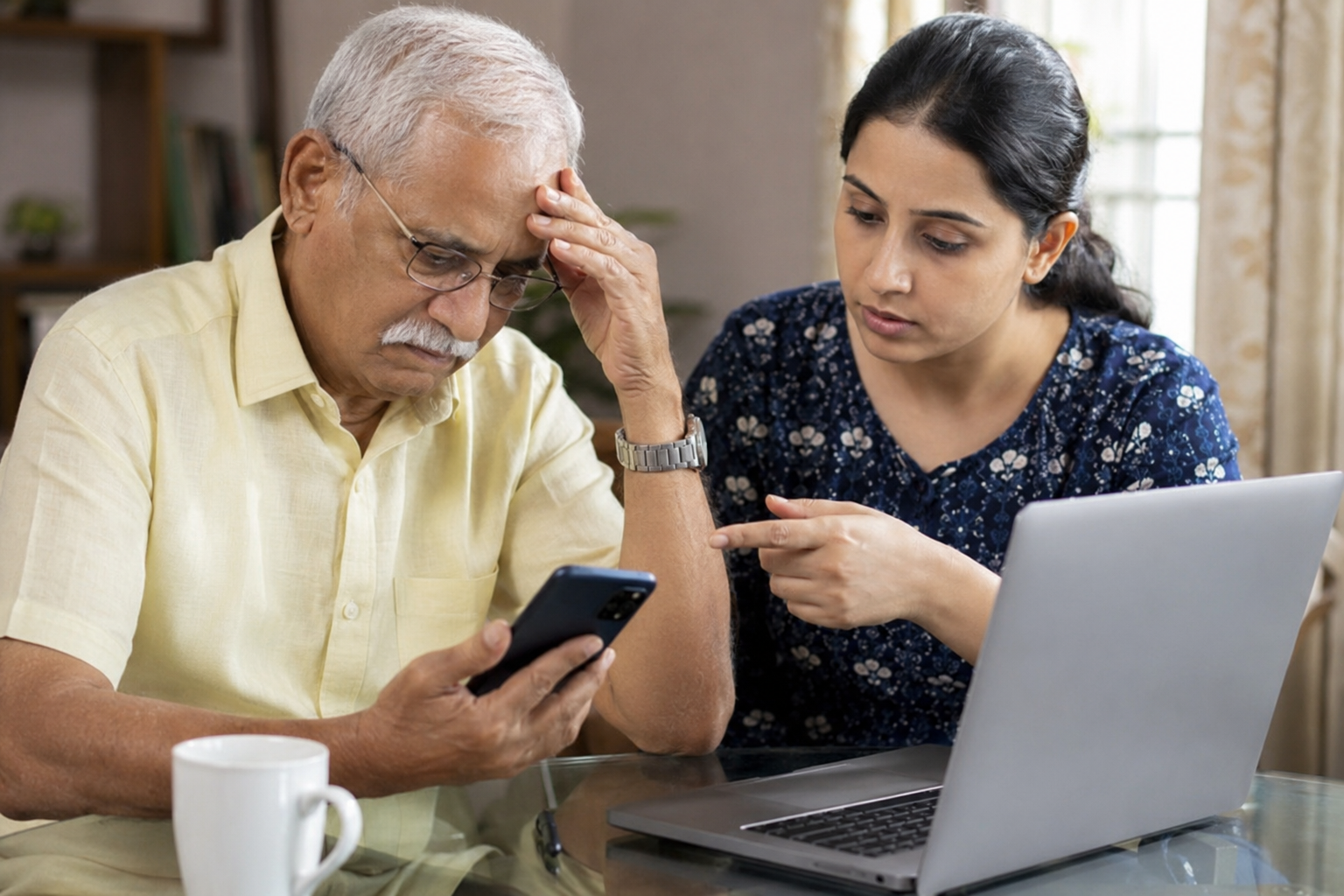
A Complete Guide for Families, Caregivers & Home Healthcare Providers
As India rapidly embraces digital banking, telemedicine, online healthcare services, UPI payments, and smartphone-based communication, a new challenge has emerged in eldercare—cyber crime.
Traditionally, elder abuse was associated with neglect, emotional mistreatment, or financial exploitation by people known to the senior citizen. Today, fraudsters can exploit seniors remotely through phone calls, fake websites, WhatsApp messages, social media platforms, and digital payment systems.
For families caring for aging parents, cyber safety has become as important as medication management, nursing care, and fall prevention.
At Six Sigma Eldercare, we believe that comprehensive eldercare includes protecting seniors not only physically and emotionally but also digitally.
Why Cyber Safety Has Become an Essential Part of Eldercare
Senior citizens are increasingly using digital platforms for:
- Online banking
- Pension management
- UPI transactions
- Teleconsultations with doctors
- Ordering medicines
- Utility bill payments
- Video calls with family members
- Hiring home nursing and caregiving services
While technology has made life easier, it has also created opportunities for cyber criminals to target vulnerable individuals.
Unlike younger generations who may have grown up with digital technology, many seniors are still adapting to rapidly changing online systems. Fraudsters exploit this gap through manipulation, urgency, and deception.
Why Senior Citizens Are Frequently Targeted
Cyber criminals often target seniors because they are perceived as more trusting and less familiar with modern cyber threats.
Common vulnerabilities include:
- Limited awareness of digital scams
- Trust in authority figures
- Fear of bank account suspension
- Living alone
- Dependence on others for online transactions
- Medical emergencies requiring quick decisions
- Reluctance to report fraud due to embarrassment
Most cyber crimes succeed not because technology is hacked but because human emotions are manipulated.
The Growing Cyber Crime Threat in India
India has witnessed a significant rise in cyber fraud cases over the past few years. Senior citizens have become prime targets for:
- OTP scams
- UPI fraud
- Digital arrest scams
- Fake KYC verification requests
- WhatsApp impersonation fraud
- Pension scams
- Identity theft
- Investment fraud
- Fake healthcare provider scams
- Remote access app fraud
Many scams begin with a seemingly harmless phone call or message.
Common Cyber Crimes Affecting Senior Citizens
1. Bank Account & OTP Fraud
Fraudsters pose as bank representatives and claim:
- KYC has expired
- Account will be blocked
- Debit card needs verification
They then ask for:
- OTP
- Debit card details
- UPI PIN
- Net banking credentials
Remember: Banks never ask for OTPs, PINs, or passwords.
2. Digital Arrest Scam
One of India’s fastest-growing frauds involves criminals pretending to be:
- Police officers
- CBI officials
- Income tax officers
- Cyber crime investigators
Victims are told:
“You are under investigation.”
“You must transfer money for verification.”
“No legitimate law enforcement agency conducts investigations in this manner.”
3. WhatsApp Impersonation Scam
Fraudsters create fake profiles using photographs of family members.
Messages often say:
- “My phone is damaged.”
- “Please send money urgently.”
- “I am in an emergency.”
Always call the known number of the relative before sending money.
4. Fake Healthcare Provider Scam
Families searching online for:
- Home nursing services
- Caregivers
- Attendants
- Physiotherapists
may encounter fraudulent websites demanding advance payments.
Warning signs include:
- No physical office address
- No caregiver verification process
- No formal agreement
- Only cash payments accepted
Always choose reputable eldercare providers with transparent processes.
5. QR Code & UPI Scams
Many seniors believe scanning a QR code helps receive money.
In reality, QR codes usually authorize payments.
Fraudsters exploit this misunderstanding to withdraw funds from victims’ accounts.
6. Investment and Pension Scams
Cyber criminals frequently target retirees with promises of:
- Guaranteed returns
- Government-backed schemes
- High-interest investments
- Pension enhancement programs
If an investment sounds too good to be true, it usually is.
How AI Is Making Cyber Fraud More Dangerous
Artificial Intelligence has transformed cyber crime.
Fraudsters can now use AI to:
- Clone voices
- Create fake identity documents
- Generate realistic photographs
- Mimic family members
- Produce convincing audio messages
Imagine receiving a call that sounds exactly like your son or daughter asking for emergency funds.
This technology is no longer science fiction.
Families must verify requests through alternate communication channels before making financial decisions.
Cyber Safety Checklist for Families
Families remain the strongest line of defence.
Essential Safety Measures
✅ Never share OTPs, passwords, or UPI PINs
✅ Enable two-factor authentication
✅ Review bank statements regularly
✅ Verify all healthcare providers before hiring
✅ Confirm caregiver identities
✅ Avoid large cash transactions
✅ Discuss common scams with elderly parents
✅ Create a family verification code for emergencies
✅ Save verified contact numbers
✅ Update smartphones and apps regularly
Family Cyber Rule
Before transferring money:
Stop → Verify → Then Act
Cyber Ethics and Responsibilities of Caregivers
Professional caregivers often have access to sensitive personal information.
Caregivers should:
- Respect client confidentiality
- Protect personal documents
- Never photograph Aadhaar or PAN cards without authorization
- Never use a client’s phone for personal purposes
- Never request direct digital payments
- Report suspicious communications immediately
- Maintain strict privacy standards
Cyber awareness should be part of every caregiver’s professional training.
Responsibilities of Professional Home Care Agencies
Trusted eldercare organizations must establish strong cyber safety standards.
Key responsibilities include:
Caregiver Verification
- Background verification
- Identity validation
- Reference checks
Secure Documentation
- Confidential handling of client records
- Restricted information access
- Privacy compliance
Transparent Billing
- Official invoices
- Secure payment channels
- No informal payment requests
Employee Training
- Cyber fraud awareness
- Data privacy protocols
- Incident reporting procedures
Families should feel confident that their loved one’s information is protected.
What To Do Immediately After a Cyber Fraud
If fraud occurs, immediate action is critical.
Step 1
Stop all transactions immediately.
Step 2
Contact your bank and request:
- Account freeze
- Card block
- UPI suspension if required
Step 3
Change passwords for:
- Banking
- Social media
- Payment apps
Step 4
Preserve evidence:
- Screenshots
- Transaction IDs
- Phone numbers
- Messages
Step 5
Report the incident through:
- National Cyber Crime Reporting Portal
- Cyber Helpline 1930
Step 6
Inform family members and healthcare providers.
Early reporting significantly improves the chances of preventing further losses.
Building a Cyber-Safe Eldercare Ecosystem
Cyber safety is no longer optional in eldercare.
A secure eldercare ecosystem requires collaboration among:
- Families
- Caregivers
- Home nursing agencies
- Hospitals
- Banks
- Technology companies
- Government authorities
Every stakeholder plays a role in protecting senior citizens from digital exploitation.
Six Sigma Eldercare’s Commitment to Safety
At Six Sigma Eldercare, our responsibility extends beyond caregiving.
Our commitment includes:
- Thorough caregiver verification
- Professional recruitment processes
- Background checks
- Ethical caregiving standards
- Secure handling of client information
- Transparent communication
- Ongoing caregiver training
- Family education on safety and fraud prevention
We believe that quality eldercare means protecting dignity, privacy, trust, and security—both offline and online.
Frequently Asked Questions
Can a bank employee ask for my OTP?
No. Banks never ask for OTPs, UPI PINs, passwords, or CVV numbers.
Should I send money to a relative who contacts me through a new WhatsApp number?
No. Always verify by calling the person’s known number.
Can caregivers manage a senior citizen’s online banking?
Only when explicitly authorized by the family and under proper supervision.
What should I do if I accidentally shared my OTP?
Contact your bank immediately, block affected accounts if necessary, and report the incident without delay.
How can I verify a home nursing or eldercare provider?
Check caregiver verification processes, company credentials, reviews, office address, agreements, and support systems before hiring.
Final Thoughts
The future of eldercare depends on more than compassionate caregiving and medical expertise. It also depends on digital trust.
Every family discussion about medicines should include a discussion about cyber safety. Every caregiver should understand the importance of protecting client privacy. Every eldercare provider should treat cyber awareness as a core component of quality care.
As technology becomes increasingly integrated into daily life, protecting seniors from cyber crime is becoming one of the most important responsibilities in modern eldercare.
At Six Sigma Eldercare, we remain committed to helping seniors live safely, independently, and with dignity—both online and offline.


